Best Email Marketing Tools for Ecommerce in 2026

The best email marketing tool for ecommerce depends on your store's complexity. Klaviyo is strong for advanced behavioural automation, Omnisend suits multichannel ecommerce campaigns, Mailchimp offers broad marketing functionality, and Brevo provides affordable contact management. For SMEs seeking fewer subscriptions, Dash to Cart combines the storefront, customer data, AI email creation, and cart recovery into a single platform.
Email marketing tools often look affordable when you first sign up. Then your customer list grows; you need better segmentation; abandoned-cart recovery becomes essential; and useful functions move into more expensive plans.
Before long, you may be paying separately for:
- Your ecommerce platform
- Email marketing software
- AI writing tools
- Customer segmentation
- Cart-recovery applications
- Analytics and forecasting
- Product review software
- Live-selling tools
- Advertising and conversion tracking
The real question is therefore not simply, “What is the best email marketing tool for ecommerce?”
A better question is:
Which platform can help my store convert more customers without creating another expensive and fragmented technology stack?
This guide compares the leading ecommerce email marketing options in 2026 and explains which type of merchant each platform is best suited to.
What should an ecommerce email marketing tool actually do?
A useful ecommerce email platform should connect campaigns to real shopping behaviour. At a minimum, it should support customer segmentation, abandoned-cart recovery, promotional campaigns, automated journeys, measurable sales attribution and integrations with the merchant’s storefront, advertising platforms and payment data.
Sending a monthly newsletter is no longer enough.
An ecommerce business needs to communicate differently with someone who has:
- Just joined the mailing list
- Viewed a product but not purchased
- Added an item to their cart
- Completed a first order
- Purchased several times
- Saved an item to their wishlist
- Stopped buying for six months
This is why automation and segmentation matter. They turn email from a broadcast channel into a customer recovery and retention system.
Recent Omnisend benchmark data found that abandoned-cart, welcome and browse-abandonment emails accounted for 87 per cent of automated orders. Its 2026 benchmark analysis also reported that abandoned-cart emails generated approximately US$3.59 per email.
Klaviyo’s ecommerce benchmarks similarly found that abandoned-cart flows delivered higher revenue per recipient than other common automated flows, with an average placed-order rate of 2.68 per cent.
The lesson is straightforward: emails that most closely match a customer’s shopping behaviour usually yield the strongest commercial results.
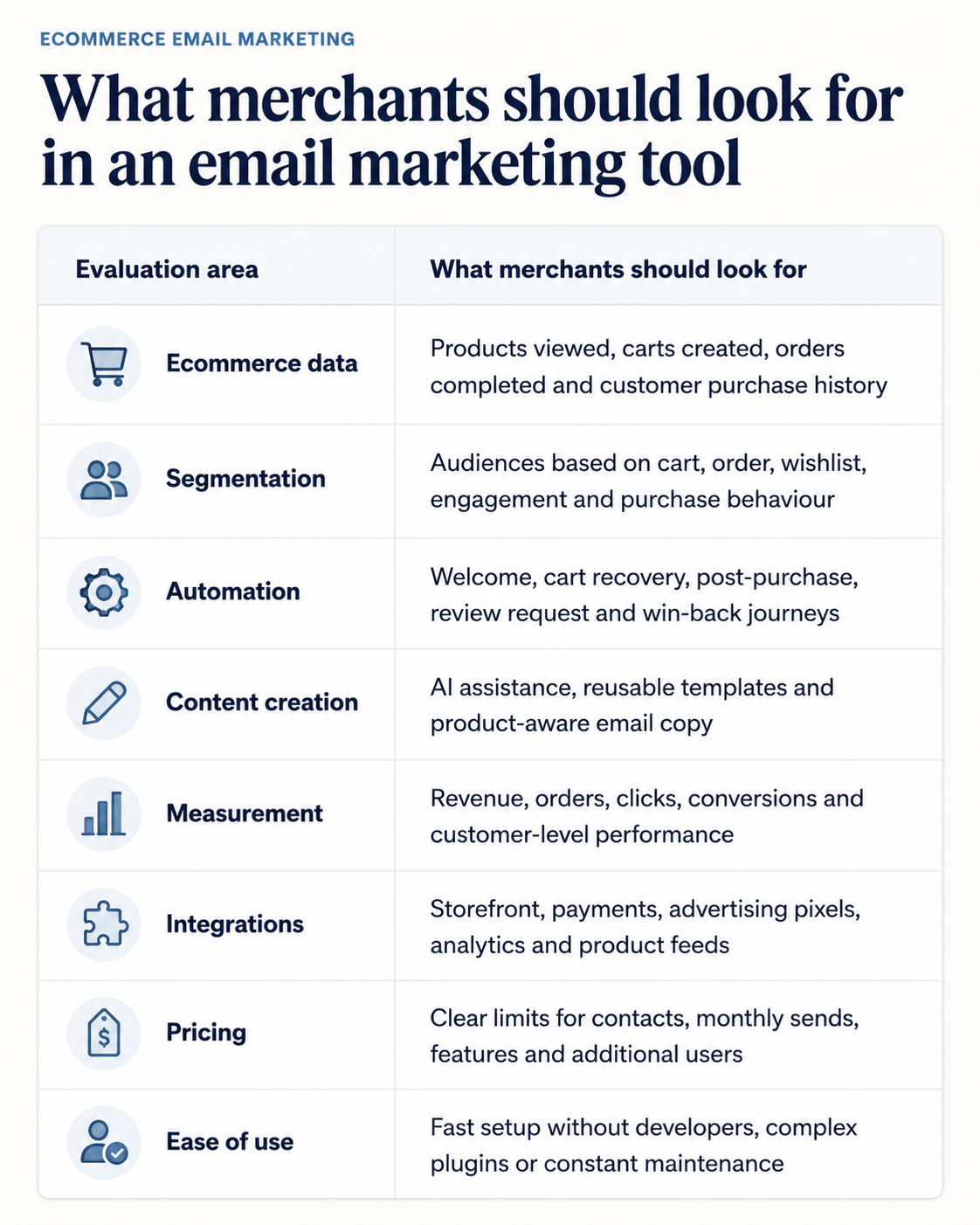
Which features matter most when comparing ecommerce email tools?
Focus on functions that directly influence revenue rather than the number of templates or decorative design options. The most important capabilities are behavioural data, useful segmentation, abandoned-cart recovery, automation, deliverability, analytics, transparent pricing and a reliable connection to the storefront.
A platform can have hundreds of functions and still be a poor choice if its data does not connect cleanly with your store.
What are the best email marketing tools for ecommerce in 2026?
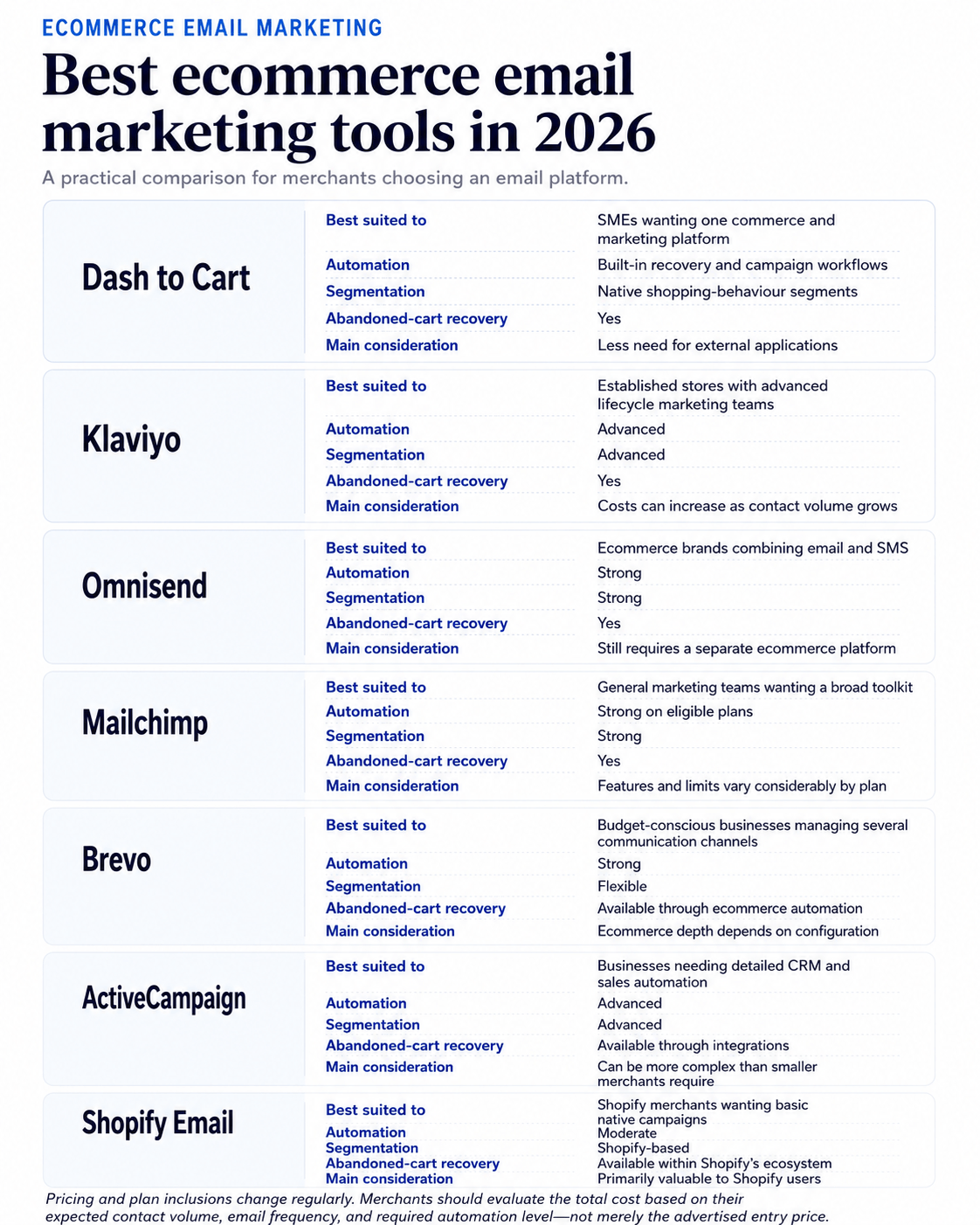
The strongest options serve different needs. Klaviyo offers sophisticated ecommerce automation; Omnisend focuses on email and SMS for online retailers; Mailchimp provides broad marketing capabilities; Brevo offers flexible customer engagement tools; and Dash to Cart integrates essential email marketing directly into an ecommerce operating platform.
Is Klaviyo the best tool for advanced ecommerce automation?
Klaviyo is one of the strongest choices for mature ecommerce businesses that need detailed behavioural segmentation and sophisticated customer journeys. It is particularly useful when a marketing team has sufficient customer data, campaign volume, and specialist resources to leverage its deeper functionality.
Klaviyo is closely associated with ecommerce lifecycle marketing. Its platform supports triggered flows such as:
- Abandoned-cart reminders
- Browse-abandonment campaigns
- Welcome sequences
- Post-purchase communication
- Product recommendations
- Customer win-back campaigns
Klaviyo states that its automation environment includes a drag-and-drop flow builder, AI-assisted flows and more than 60 customisable templates.
Its strength is depth. A merchant can create highly specific audiences based on buying frequency, average order value, product interests and previous interactions.
The trade-off is operational complexity. Advanced segmentation only creates value when someone can plan, write, test and continually improve the flows. Smaller merchants may find themselves paying for capabilities that remain underused.
Best for: Scaling direct-to-consumer brands with dedicated ecommerce marketers.
Is Omnisend better for email and SMS marketing?
Omnisend is a strong option for ecommerce brands that want email and SMS workflows in a single marketing platform. It offers ecommerce-focused templates, segmentation and cart-recovery automation while remaining more approachable than some enterprise-oriented systems.
Omnisend is built specifically around ecommerce rather than general business newsletters. It connects with platforms such as Shopify and WooCommerce and supports automation based on customer shopping activity.
Its abandoned-cart functionality can use customer information and browser cookies to identify some cart abandoners, improving the opportunity to re-engage shoppers.
Omnisend is particularly useful for merchants who want to coordinate:
- Email campaigns
- SMS messages
- Signup forms
- Product recommendations
- Cart-recovery sequences
- Customer lifecycle journeys
Its weakness is not the marketing functionality itself. It is that merchants still need a separate ecommerce platform, storefront and supporting application stack.
Best for: Growing online retailers that treat email and SMS as major revenue channels.
Is Mailchimp still suitable for ecommerce?
Mailchimp remains a capable choice for businesses wanting email campaigns, templates, audience management and broader marketing functions in one familiar system. Its automation and ecommerce features are useful, although merchants must check which functions are included in each plan and how pricing changes as their contact database grows.
Mailchimp supports abandoned-cart automation, customer journeys and ecommerce data integrations. Its automation flows can trigger messages after a shopper leaves products behind and schedule a sequence designed to bring the customer back.
The platform is suitable for businesses that need more than ecommerce email, including:
- Newsletters
- Landing pages
- Forms
- General audience management
- Creative templates
- Marketing analytics
Mailchimp has also expanded its AI-assisted content creation and offers more than 300 email templates.
However, its broad scope can be both an advantage and a disadvantage. Ecommerce merchants should confirm that their preferred automation, segmentation and testing features are included in the selected plan. Mailchimp states that automation functionality varies by plan type.
Best for: Businesses seeking a familiar, multipurpose marketing platform.
Is Brevo a good affordable alternative?
Brevo is a practical option for businesses seeking email marketing, automation, transactional email, SMS, CRM and customer communication without relying entirely on contact-based pricing. It is attractive to cost-conscious merchants, although deeper ecommerce use cases may require more integration and configuration.
Brevo positions itself as a broader customer engagement platform that combines email, SMS, automation, CRM, live chat, and transactional messaging.
This makes it useful for companies that manage both marketing communication and sales relationships.
Its advantages include:
- Marketing automation
- Contact segmentation
- Transactional communication
- SMS and messaging options
- CRM functionality
- Multi-channel customer management
Brevo can be economical, but merchants should assess whether it captures enough product, cart and order behaviour from their ecommerce system. Affordable sending is less valuable when customer data remains disconnected.
Best for: SMEs that need flexible communication and CRM tools across several channels.
When does an all-in-one ecommerce platform make more sense?
An all-in-one platform makes sense when a merchant needs reliable core marketing functions but does not want to maintain several subscriptions and integrations. Native email, customer data, products, orders, payments and analytics reduce data gaps and allow campaigns to be launched from the same dashboard used to operate the store.
This is where Dash to Cart takes a different approach.
Instead of functioning only as an email service provider, Dash to Cart combines the merchant’s storefront, products, customers, payments, analytics and marketing tools.
Merchants can segment customers based on signals such as:
- Has an abandoned cart
- Has recently completed an order
- Has completed at least one order
- Has recently added a product to a wishlist
They can then create promotional or recovery emails within the dashboard. The native Do Magic AI writing assistant generates email copy, while abandoned-cart records can be opened and recovered without exporting customer information into another application.
Because these capabilities are directly connected to the store, merchants avoid repeatedly synchronising products, customers, and transaction events between separate systems.
Why is Dash to Cart different from a standalone email tool?
Dash to Cart is not merely an email marketing application. It is an ecommerce platform with native customer recovery, AI content, analytics, discovery, live-selling and advertising integrations. Its value comes from connecting the complete selling process rather than optimising email in isolation.
One subscription instead of several disconnected tools
Dash to Cart’s paid subscription starts from US$20 per month, with a strict 0 per cent platform transaction fee on the paid plan. Standard Stripe payment-processing charges still apply.
The platform connects directly to Stripe for payment processing and payouts. Dash to Cart does not store customers’ card information, while merchants retain ownership of their customer, order and business data.
Dash to Cart now powers more than 1,000 active merchant stores, and 35 per cent are actively generating cross-border international sales.
For SMEs, the potential savings are not just from email subscriptions. It is the combined cost of replacing or reducing multiple applications.
Native AI Content Engine
The platform’s AI tools help merchants create:
- Product descriptions
- SEO-friendly product content
- Promotional emails
- Abandoned-cart messages
- Marketing copy
The AI writer works within the product and email workflows, reducing the need to move content between a chatbot, a document, and an ecommerce dashboard.
Global Discovery Network
Most standalone email tools communicate only with people already in the merchant’s database.
Dash to Cart’s Global Discovery Network addresses an earlier part of the funnel by helping buyers discover products and merchant stores. This gives sellers another traffic source before email retention begins.
The combination matters:
- Discovery attracts new visitors.
- The storefront converts them into shoppers.
- Customer data supports segmentation.
- Email marketing brings them back.
- Analytics identifies the next growth opportunity.
Instant Sale Sessions for live selling
Merchants can create time-limited Instant Sale Sessions with dedicated products, countdown functionality and a shareable sales page.
The page can support live-selling activities conducted through:
- TikTok
- Zoom
- Google Meet
- Physical events
- QR codes
Instead of asking viewers to search through a full catalogue, sellers can direct them to a focused page containing the products featured during the live session. Dash to Cart has continued to enhance Sale Sessions with calendar links, duplication tools, and improved checkout behaviour.
Meta Pixel and Google Tag Manager tracking
Email performance should not be viewed separately from paid advertising.
Dash to Cart supports integrations with:
- Meta Pixel
- Google Tag Manager
- Google Analytics 4
- TikTok Pixel
- Hotjar
- Custom tracking scripts
These integrations allow merchants to track customer behaviour, optimise advertising and build retargeting audiences without rebuilding their storefront.
AI sales forecasting and analytics
Dash to Cart’s analytics dashboard helps merchants monitor:
- Product views
- Add-to-cart activity
- Traffic sources
- Devices
- Best-performing products
- Payments and payouts
- Customer behaviour
- Time-based sales patterns
Its AI-generated analysis can identify low-performing products, high-exit pages and traffic trends. Predictive sales insights help merchants forecast demand and adjust campaigns, inventory, and promotional timing from a single operating dashboard.
Native product reviews
Dash to Cart includes product reviews and ratings without requiring a separate review application.
Buyers can submit reviews, including anonymous reviews, while merchants can view rating summaries. The platform also sends review reminders after an order is completed, adding social proof to product pages and helping future buyers purchase with greater confidence.
Global syndication channels
Dash to Cart helps merchants extend their reach beyond their storefronts by connecting to Google Merchant Centre and participating media websites.
Product syndication can support:
- Google Shopping visibility
- Organic product discovery
- External referral traffic
- Brand awareness
- Broader international exposure
This makes email one component of a larger acquisition, conversion and retention system.
Which email marketing tool should your ecommerce business choose?
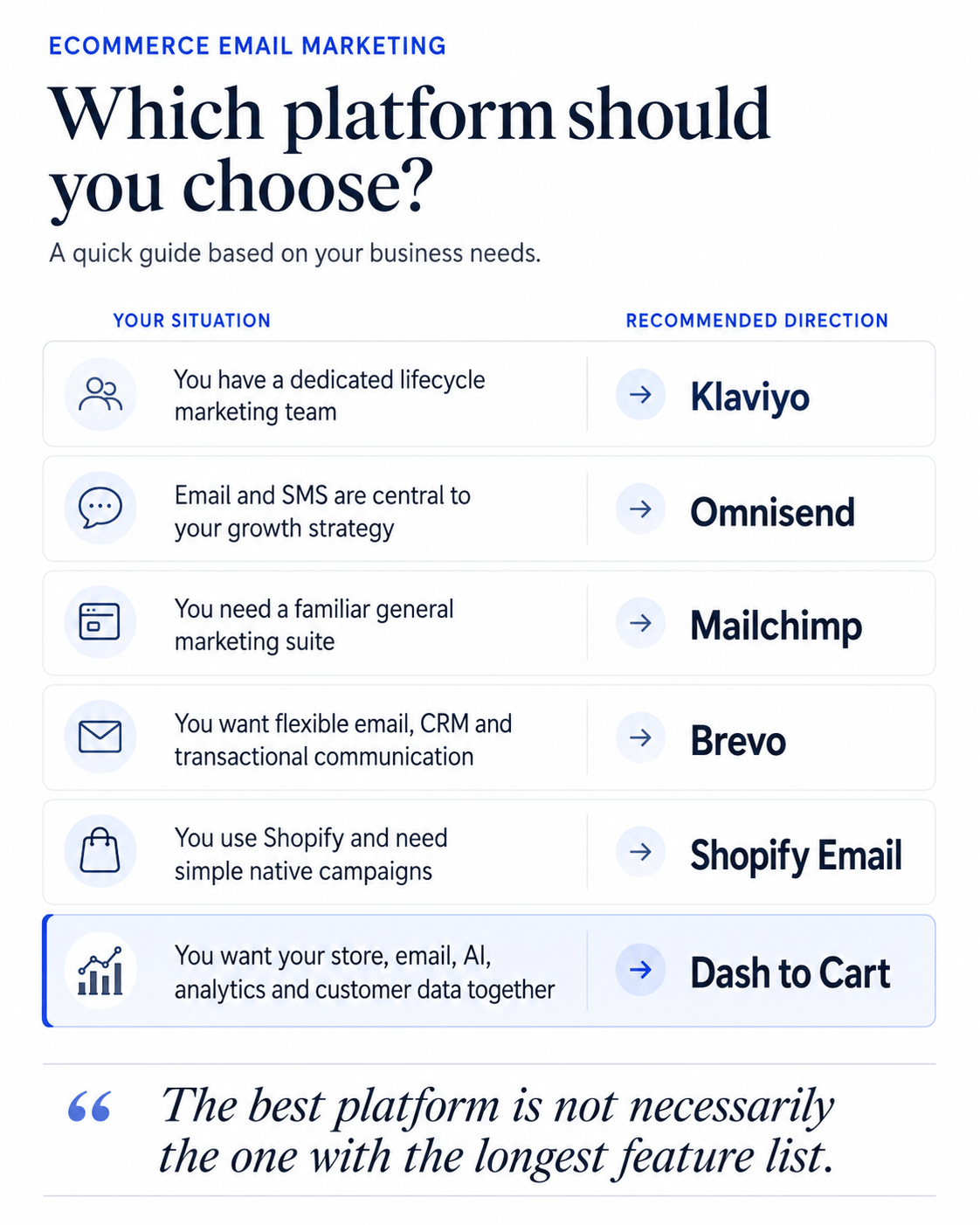
Choose according to your operating model. Large brands needing complex lifecycle orchestration may prefer Klaviyo. Email-and-SMS-led retailers may favour Omnisend. General marketing teams may choose Mailchimp or Brevo. SMEs seeking an ecommerce storefront with built-in email, AI, discovery and analytics should consider Dash to Cart.
It is the one your team can operate consistently, measure accurately and afford as the business grows.
Why Dash to Cart is a strong choice for SMEs in 2026
Dash to Cart is a strong choice for SMEs because it removes much of the cost and technical friction created by separate ecommerce and marketing tools. Merchants can build a store, accept Stripe payments, recover carts, generate email content, analyse sales, collect reviews and gain product exposure from one platform.
A sophisticated email platform may be justified when a store has hundreds of thousands of contacts and a specialised retention team.
Most SME owners are in a different situation. They are managing products, fulfilment, customer enquiries, advertising, cash flow and content often with a very small team.
They do not need more dashboards. They need fewer points of failure.
Dash to Cart’s advantage is therefore structural:
- Store and customer data are already connected.
- Products do not need to be synchronised manually.
- Abandoned carts are visible inside the customer dashboard.
- AI can generate recovery and promotional copy.
- Stripe payments and payouts operate in the same environment.
- Tracking tools connect campaigns to customer actions.
- Discovery and syndication help acquire buyers, not only email existing ones.
- Paid plans charge a flat subscription fee starting at US$20 per month, with 0 per cent platform transaction fees.
For merchants comparing total cost, operational time and sales capability, not simply email volume, this can be more valuable than subscribing to another standalone marketing application.
Frequently asked questions
What is the best email marketing tool for ecommerce?
The best tool depends on your needs. Klaviyo is suitable for advanced ecommerce automation, Omnisend for coordinated email and SMS, Mailchimp for general marketing, and Brevo for flexible customer communication. Dash to Cart is well suited to SMEs wanting email marketing, customer data, AI content and ecommerce operations in one platform.
What is the best email marketing tool for a small ecommerce business?
Small ecommerce businesses should prioritise ease of use, cart recovery, segmentation and predictable costs. An all-in-one platform such as Dash to Cart can reduce setup work and external subscriptions by including these functions directly within the merchant dashboard.
Do I need a separate email marketing subscription for my online store?
Not always. Some ecommerce platforms include native email tools. Dash to Cart allows paid-plan merchants to create AI-assisted promotional emails, target customer segments and recover abandoned carts without subscribing to a separate email marketing platform.
Can email marketing recover abandoned carts?
Yes. Abandoned-cart emails remind shoppers about products they intended to buy and provide a direct route back to checkout. Industry benchmarks consistently show that cart-recovery flows are among the highest-revenue ecommerce email automations.
What customer segments should an ecommerce store create?
Useful segments include first-time buyers, repeat customers, abandoned-cart shoppers, recent purchasers, wishlist users, inactive customers, high-value customers and buyers interested in specific product categories.
Is Klaviyo better than Mailchimp for ecommerce?
Klaviyo generally offers deeper ecommerce segmentation and behavioural automation. Mailchimp provides a broader general-purpose marketing toolkit and may be easier for businesses with mixed marketing requirements. The better choice depends on campaign complexity, team capability and budget.
Is Dash to Cart an email marketing platform?
Dash to Cart is an ecommerce platform with built-in email marketing capabilities. It combines storefront creation, products, customers, Stripe payments, AI-assisted emails, abandoned-cart recovery, analytics, reviews, live-selling tools and marketing integrations.
Does Dash to Cart charge transaction fees?
Dash to Cart’s paid plan starts from US$20 per month and charges a 0 per cent platform transaction fee. Stripe payment-processing fees still apply. The free plan may use a success-fee model.
Can Dash to Cart connect with Meta and Google tracking tools?
Yes. Dash to Cart supports Meta Pixel, Google Tag Manager, Google Analytics 4, TikTok Pixel and custom scripts, enabling merchants to measure customer actions and optimise advertising campaigns.
Can Dash to Cart help products reach buyers outside the merchant’s website?
Yes. Its Global Discovery Network and syndication channels help products gain additional visibility through Dash to Cart discovery, Google Merchant Center and participating media channels. This complements email marketing by bringing new potential customers into the sales funnel.
Should a new ecommerce store begin with advanced email automation?
A new store should begin with the highest-impact fundamentals: a welcome message, abandoned-cart recovery, post-purchase communication, review requests and occasional targeted promotions. More complex flows should be added only when the store has enough customer data and resources to manage them properly.